Shipbuilding steel grades are specialized structural steels designed for marine environments classified by classification societies (ABS, DNV, LR) into normal strength (A, B, D, E) and high strength (AH, DH, EH, FH). They offer high toughness, good weldability, and corrosion resistance with thicknesses ranging from 3 mm to 400 mm.
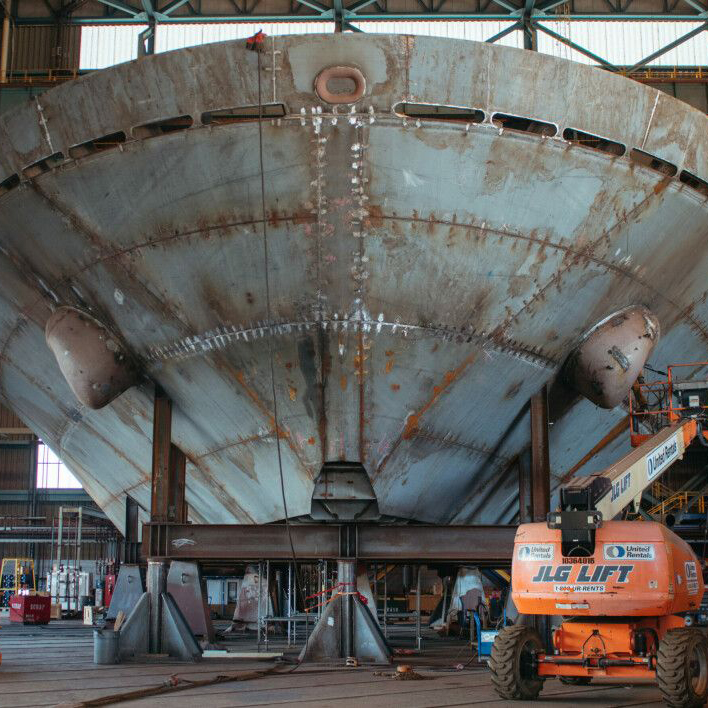
A ship needs for its construction various types of steels in the form of hot-rolled plates, strips, different sections (including hollow sections), flat bars, rods, bars, and tubular products. The ship construction also needs some specialized shapes like unequal legs and unequal thickness angles
Common Shipbuilding Steel Grades:
Normal Strength (Mild Steel):
GRADE A STEEL
Grade A Steel is used for Ship Structures measuring less than 20 mm such as Bulkheads.
GRADE B STEEL
Grade B Steel, slightly stronger Steel is used for structures measuring 20 to 25 mm.
GRADE D STEEL
Grade D Steel is strong enough to Resist Cracks and is used for Structures that measure more than 25 mm thick.
GRADE E STEEL
Grade E Steel is Heat Treated for the Ultimate Strength and is used for Structures Measuring 50 mm or more making it the Ideal Material for High-Stress Parts of the Ship such as the Keel.
High Strength (High Tensile Steel):
AH32/36/40: Common for Large Vessel Hulls and Bulk Carriers.
DH32/36/40: Used for Ship Superstructures and High-Stress Areas.
EH32/36/40: Suitable for extreme Structural Loads.
FH32/36/40: Used in Cold Climate applications Tested down to -60∘C.
Key Characteristics and Selection:
Impact Strength: Grades A-F indicate increasing impact toughness (0°C, -20°C, -40°C, -60°C).
Thickness: Mild steel (A) is often used for plating <20 mm, while higher grades (D/E) are used for thicker, highly stressed sections.
Yield Strength: High-Strength Steels (32, 36, 40) provide Stronger, Lighter Construction, increasing from 315 N/mm² to 390 N/mm².
Certifications: Commonly certified by societies like ABS, CCS, DNV-GL, and LR.
Structural steel details comprise specialized shapes (I-beams, channels, angles, and tubes) used for high-strength, durable, and ductile construction in buildings, bridges, and industrial projects. Key aspects include a high strength-to-weight ratio, easy on-site welding/bolting, and superior durability against loads. Key standards such as IS and EN standards ensure structural integrity and compliance.
Common Structural Steel Shapes:
I-Beams (H-Beams/W-Shapes): Horizontal load-bearing common in building frames and columns.
Channels (C-Shapes): C-shaped used for roof purlins, windows, and wall studs.
Angles (L-Shapes): L-shaped for supports, trusses, and bracing.
Tubular/Hollow Sections (HSS): Square/rectangular/circular, known for high torsion resistance, ideal for columns.
Plates/Flat Forms: Used for Strengthening Connections or Specialized Fabrication.
Key Technical Properties:
Strength & Elasticity: High Tensile Strength (410−550 MPa) with a modulus of elasticity at roughly 200 GPa.
Ductility: Allows for deformation without failure, critical for resisting seismic loads.
Weldability & Fabrication: Easily welded and cut on-site, allowing for fast, modular assembly.
Fire & Corrosion Resistance: While not combustible, structural steel loses strength at temperatures above 500°C and requires anti-corrosion coating.
Fabrication and Connection:
Structural steel components are manufactured (rolled or welded) and then fabricated (cut, drilled, and welded) to exact specifications.
Connections: These are typically achieved through welding, bolting, or riveting to ensure high load-bearing capacity.
Steel for Structural Applications:
Construction of Bridges
Ship Building (Hull Structures, Decks, Bulkheads)
Industrial Structure
Commercial Towers
Hydro Power & Wind Farms
Modules, Offshore Platforms & Marine Engineering
Steel Structure Fabrication
Oil Rigs & Floating Structures
Naval & Commercial Vessels
Structural Steel:
Structural Steel is a highly Versatile Material that can be used in various Industries. Structural Steel is typically categorized into types based on criteria like Chemical Composition, Physical Properties and Usage. Here are the most common types of Steel:
Carbon Steels
Alloy Steels
Stainless Steels