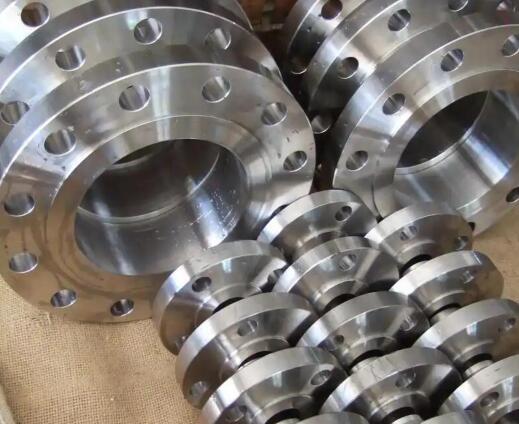
Flanges are forged or cast steel rings used to connect pipes, valves and pumps, forming a piping system that allows for easy cleaning, inspection or modification. They are attached via welding, threading or bolting, often using gaskets to ensure a tight seal. Key standards include ASME B16.5, with common types being weld neck, slip-on and blind.
Key Types of Flanges:
Weld Neck Flange: Features a long-tapered hub designed for high-pressure and high-temperature applications.
Slip-On Flange: Slips over the pipe, allowing for easier alignment and lower cost.
Blind Flange: A solid disc with no bore used to blank off pipeline ends or openings.
Socket Weld Flange: Used for Small-Diameter, High-Pressure Piping.
Threaded Flange: Assembled without welding, suitable for specialised low-pressure applications.
Lap Joint Flange: Used with a stub end, ideal for systems requiring frequent dismantling.
Flange Facing Types:
Raised Face (RF): Features a small raised section around the bore common for higher pressure applications.
Flat Face (FF): Used when mating materials are brittle.
Ring Type Joint (RTJ): Features a metal ring gasket to maintain a seal under high-pressure and high-temperature conditions.
Tongue & Groove (T&G): Self-aligning and provides a secure seal.
Pressure-Temperature Ratings:
Flanges are classified by pressure-temperature ratings (ASME B16.5) and are commonly rated in pressure classes such as 150 lb, 300 lb, 600 lb, 900 lb, 1500 lb and 2500 lb.
Common Materials and Sizes:
Materials: Forged Carbon Steel (ASTM A105), Low-Alloy Steel (ASTM A350), Stainless Steel (ASTM A182) and Duplex Steel.
Sizes: Typically range from 1/2 inch to 24 inches (nominal pipe size).
Dimensions: Include the Pitch Circle Diameter (PCD), Bolt Size, Hub Diameter and Outer Diameter.
Flange Marking:
Flanges are marked to identify their specifications, including:
Nominal Size
Pressure Class
Material Grade
Manufacturer’s Mark
Batch Number